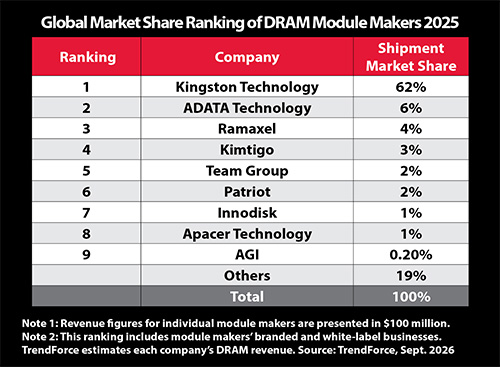
Kingston is touting its 23rd straight year as the world's top third-party DRAM module supplier, with a 62 percent share of a market TrendForce says generated $21.2 billion in 2025. The more useful number buried in that release isn't Kingston's share. It's the 59 percent jump in total market revenue, because that growth wasn't driven by people buying more memory. It was driven by memory costing more.
TrendForce's own explanation, which Kingston quotes directly, says cloud providers scaling up agentic AI workloads significantly increased server DRAM consumption through 2025, eating into the supply that would otherwise go to PC and consumer parts. Less DRAM available for consumer builds, with demand unchanged, is a plain supply and price story. Kingston calling it "strengthened" pricing is the polite version of the same fact.
The DDR4 wind-down made the squeeze worse before it got better
Earlier in 2025, module makers were still stockpiling DDR4 ahead of tariff concerns and suppliers winding down DDR4 production entirely. That meant two supply pressures hit the consumer channel at once: an end-of-life part getting harder to source, and a current-gen part getting diverted to enterprise customers. Kingston says its own revenue grew 48 percent year over year navigating that exact squeeze, which tracks with a company whose procurement scale lets it hold and allocate inventory more aggressively than smaller rivals.
The market concentration number is also worth sitting with. The top five DRAM module suppliers combined hold only 77 percent of total revenue, and Kingston alone accounts for nearly two thirds of the whole market. That's not a crowded field with Kingston slightly ahead. It's one company with a scale advantage over everyone else in the category combined.
What this means if you're shopping for RAM, not reading a market report
Kingston frames its B2B expansion into data center and AI infrastructure customers as a growth engine, and the release spends more words on enterprise and industrial applications than on client PCs or gaming systems, which used to be the default audience for a DRAM press release. That shift in emphasis is itself a signal. If the company with the largest consumer module business is now talking primarily about servers, the DRAM aisle at your local PC shop is increasingly a side effect of decisions being made somewhere else entirely, in data centers most PC builders will never see.