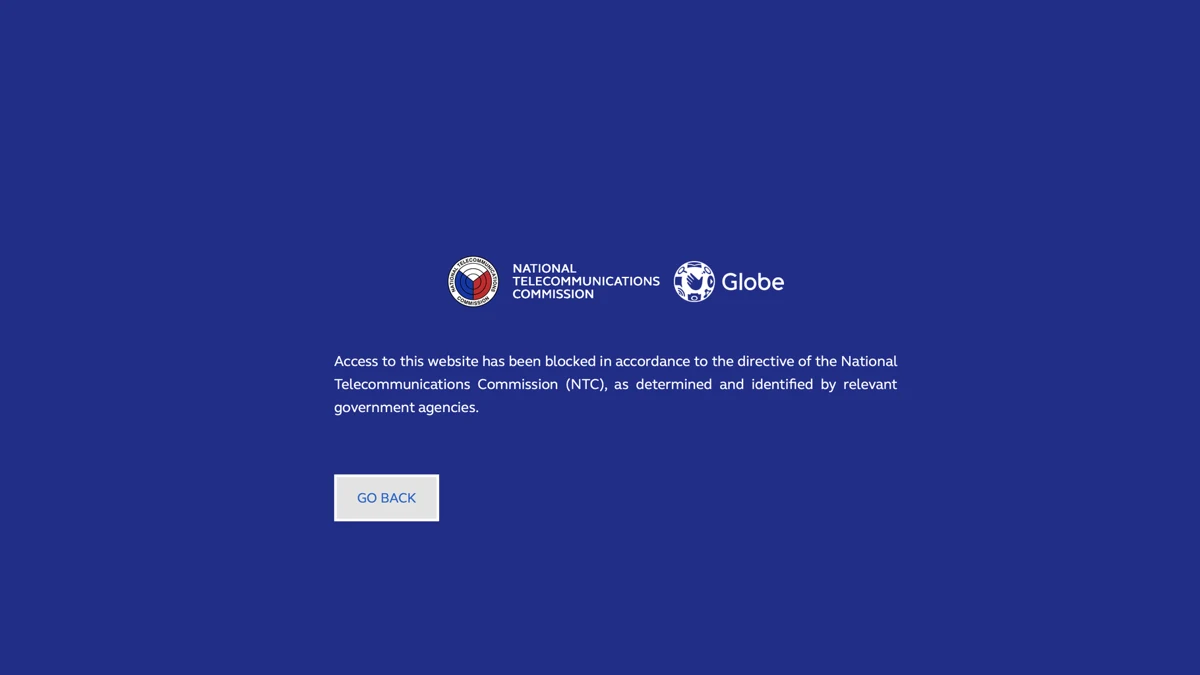
UPDATE (September 24): The Discord block is over. The government lifted it after the platform agreed to a set of child safety commitments. The fight over whether the block should have happened at all is only getting started, and demand letters have already gone out to the DICT, CICC and NTC.
Discord went dark for several hours on a number of Philippine networks starting September 23, when discord.com and discord.gg began loading a "Forbidden Access" page carrying the National Telecommunications Commission (NTC) and Globe logos. On September 24, DICT Secretary Henry Aguda and Cybercrime Investigation and Coordinating Center (CICC) Executive Director Renato "Aboy" Paraiso announced the block was being lifted, TechSabado reports.
What Discord agreed to
Paraiso said the deal came out of a meeting with Discord officials on Thursday. The centerpiece is a "green lane," a direct channel between Discord and Philippine authorities for urgent requests involving harmful content and online threats. Reddit, which got an extension on the same 24-hour directive, agreed to a similar arrangement.
Discord also committed to monitoring and identifying threat actors on the platform. It will either designate personnel in the Philippines or set up a local satellite office to handle coordination with authorities. "Sa mga platforms na 'to, wala na hong makakapagtago na nananamantala at nananakit sa ating mga kabataan," Paraiso said at the press conference. (On these platforms, those who exploit and harm our children will no longer be able to hide.)
According to Paraiso, both Discord and Reddit have already named point persons that the government can reach 24/7, and the green lane covers takedown requests as well as requests for the credentials of threat actors. The next round of talks will set milestones and timelines for the rest. He pitched the targeted approach as a way to go after bad actors "at hindi maapektuhan 'yung mga lehitimong gumagamit" (without affecting legitimate users).
Aguda said Discord acknowledged that parts of its policies need fixing. "Mahalagang linawin na ang ban ay ipinatupad natin para lamang sa isang layunin. Ang kaligtasan at proteksyon ng ating mga anak. Walang ibang motibo sa likod ng hakbang na ito," he said. (It is important to clarify that we imposed the ban for only one purpose: the safety and protection of our children. There is no other motive behind this step.)
Paraiso also apologized to users caught in the block. "Kukunin ko na rin po itong pagkakataon na 'to para humingi ho ng pasensya sa lahat ho ng mga naapektuhan at naabala," he said. (I'll take this opportunity to apologize to everyone affected and inconvenienced.) He added that the government will keep close watch on whether both platforms deliver on their promises.
How the block went down
Officials said the CICC wrote to the NTC on September 23, and ISPs began implementing the block at around 5 p.m. that day. According to TechSabado, Discord was reported inaccessible on Globe, GOMO, TNT and DITO. Reports on PLDT and Smart were mixed.
On September 22 the CICC had given Discord and Reddit 24 hours to appoint a local representative and submit plans on age verification, rapid response and child exploitation safeguards. It followed the September 18 shooting at Banga National High School in South Cotabato. In a later clarification, the CICC said only Reddit got an extension because its officials met with the agency inside the deadline, while Discord had only sent a letter.
Asked by ABS-CBN News why the government now seemed flexible on timelines after a 24-hour ultimatum, Paraiso said the directive was always to establish a "Philippine presence," not necessarily a physical office. "It's a win for the Filipino children. It's a win for the Philippines and it's a win for the platform," he said.
Why Discord, and why a whole-platform block
Paraiso said Discord and Reddit were singled out because investigators found both were used in recent incidents involving Nihilistic Violent Extremism (NVE). He described a pattern where groomers first make contact on social media or gaming platforms, then move targets to more private spaces. Discord, he said, is one of them, and he claimed its private communities and messaging were being exploited for grooming, a point he said Discord agreed with during the meeting.
Aguda used a shopping mall analogy to explain why the government went after the whole platform instead of specific users. Most stores in a mall sell legitimate goods, he said, but if a few are selling illegal ones and authorities cannot get inside, the mall operator has to police its own space. "Imagine niyo isang mall, alam natin may ilegal na nangyayari pero hindi kami makapasok," he said. (Imagine a mall where we know something illegal is happening, but we can't get in.) The green lane, in his framing, is the deal where the government flags the problem store and the operator shuts it down.
He also admitted the decision was not an easy one. "Hindi po madaling desisyon ang mag-ban ng isang platform," he said. (Banning a platform is not an easy decision.)
Officials added that the DILG and PNP stopped 55 NVE-related threats within a single week, and that the effort involves the NBI, DOJ, DSWD and DepEd.
Meta could be next in line
The briefing also turned to Facebook. Aguda said the government has been talking to Meta for more than a year, has sent two letters to Mark Zuckerberg and has asked the US government for help through the Philippine embassy. He said Meta agreed to a draft set of safety protocols with its Asia Pacific leadership but has not signed it.
He stopped short of threatening a ban, pointing instead to court action like the cases Meta has faced in the US and EU. "Kung ayaw makipag-usap, eh baka sa korte na lang tayo mag-uusap," he said. (If they don't want to talk, maybe we'll just talk in court.) He also acknowledged that a Facebook ban would carry far more economic and social impact than the Discord block did.
Demand letters are out, a Supreme Court petition may follow
Lifting the block did not end the fight. Jeffrey Ian Dy, a cybersecurity specialist and former DICT undersecretary, said in a Facebook post Thursday evening that he and his lawyer had sent demand letters to the DICT, CICC and NTC, TechSabado reports. The letters ask the agencies to stop blocking Discord and any other app in the future.
"This may look moot and academic, but this afternoon, my lawyer and I sent demand letters to DICT, CICC and NTC to ask them to cease and desist from blocking Discord now, or any other apps in the future," Dy said.
Dy's argument against the "moot and academic" label is that the threat has not gone away. He said his lawyers are studying a Supreme Court filing, possibly a petition for mandamus or certiorari, "especially since the unlawful order to block is continuing," pointing to the DICT's statements that Reddit, Discord and possibly Meta were only given extensions. The challenge would test the constitutionality of website blocking against the Supreme Court's Disini v. Secretary of Justice ruling.
He is not the only one lining up. Dy said he met with groups including BetterGov.PH and Democracy.Net.PH, which are considering their own Supreme Court petition, and that other groups are planning to challenge what he called an overreach by the DICT. "This is no longer about Discord. This is already about our freedom in the internet, which for some of us, brings food to the table," he said.
That livelihood angle has been central to Dy's criticism from the start. He estimated that between 15,000 and 25,000 Filipino gig workers use Discord to find work, including as virtual assistants and online encoders. He also questioned treating online harm purely as a cybersecurity problem. "Cybersecurity is when there is an attack on confidentiality, integrity and availability of computer resources," he said. "Online harm is a problem that is multidimensional."
Asked at the briefing whether public backlash drove the reversal, Paraiso said that talking to people who lost work or had to move their business is still easier than facing parents who lost a child. "That's a hard conversation to have," he said.
Democracy.Net.PH also pushed back in a statement posted on its Facebook page after the DICT-CICC briefing. The group argued that decisions to restrict platforms belong to the courts or Congress, not executive agencies, and questioned whether the government had data showing the platforms were the cause of the harm. "We reiterate: the DICT, as an executive agency, has no right to threaten platforms and then to ban them, for refusing to negotiate with them," the group said.
Does the CICC have the power to block sites?
The government's answer is a centuries-old legal doctrine. At the September 24 press briefing, Paraiso invoked parens patriae, Latin for "parent of the country," to justify the Discord block, Newsbytes.PH reports. The doctrine casts the State as a guardian for those who cannot fully protect themselves, most often children. Responding directly to Dy's claim that a block needs a court order, Paraiso argued that the 2014 Supreme Court case Dy was referring to dealt with freedom of expression, while this one rests on the State's duty to protect. "Hindi nga right eh, obligasyon ho ng estado under the parens patriae doctrine," he said. (It's not even a right, it's an obligation of the State under the parens patriae doctrine.)
Paraiso also pitched local presence as a two-way benefit. Without a legal entity in the country, he argued, authorities have no recourse against a platform. A Philippine office or designated representative would give the government someone to deal with and, by his account, give the platform its own footing too.
Critics are not convinced that a general doctrine fills the gap left by the law. A legal analysis by Geronimo Law, also reported by Newsbytes.PH, notes that the CICC has coordination and policy functions but no express statutory authority to order a website or app blocked just because it has been used for cybercrime.
The one provision that once allowed blocking under the Cybercrime Prevention Act, Section 19 of Republic Act 10175, was struck down by the Supreme Court in Disini v. Secretary of Justice in 2014. That provision had let the Department of Justice restrict access to computer data it found prima facie in violation of the law. The analysis points out that blocking powers do exist elsewhere. Courts can issue warrants, the NTC can direct ISPs to block in specific regulatory cases such as unlicensed gambling, and separate laws cover child sexual abuse material and trafficking content. None of these is a general power to take down an entire platform.
Whether Disini applies directly to an NTC-implemented block is itself a question only the courts can settle. That sets up the core issue for any petition Dy and the civic groups file: whether a guardianship doctrine can stand in for a specific law authorizing the block.
What happens next
For Discord users the practical problem is solved, at least for now. The bigger questions are still open: whether Discord delivers on its green lane and local presence, whether Meta ends up in the same spot, how the DICT, CICC and NTC answer Dy's demand letters and whether the Supreme Court gets to rule on who actually has the authority to pull the plug.
We will update this story as petitions are filed and as the DICT, CICC and Discord share more details.