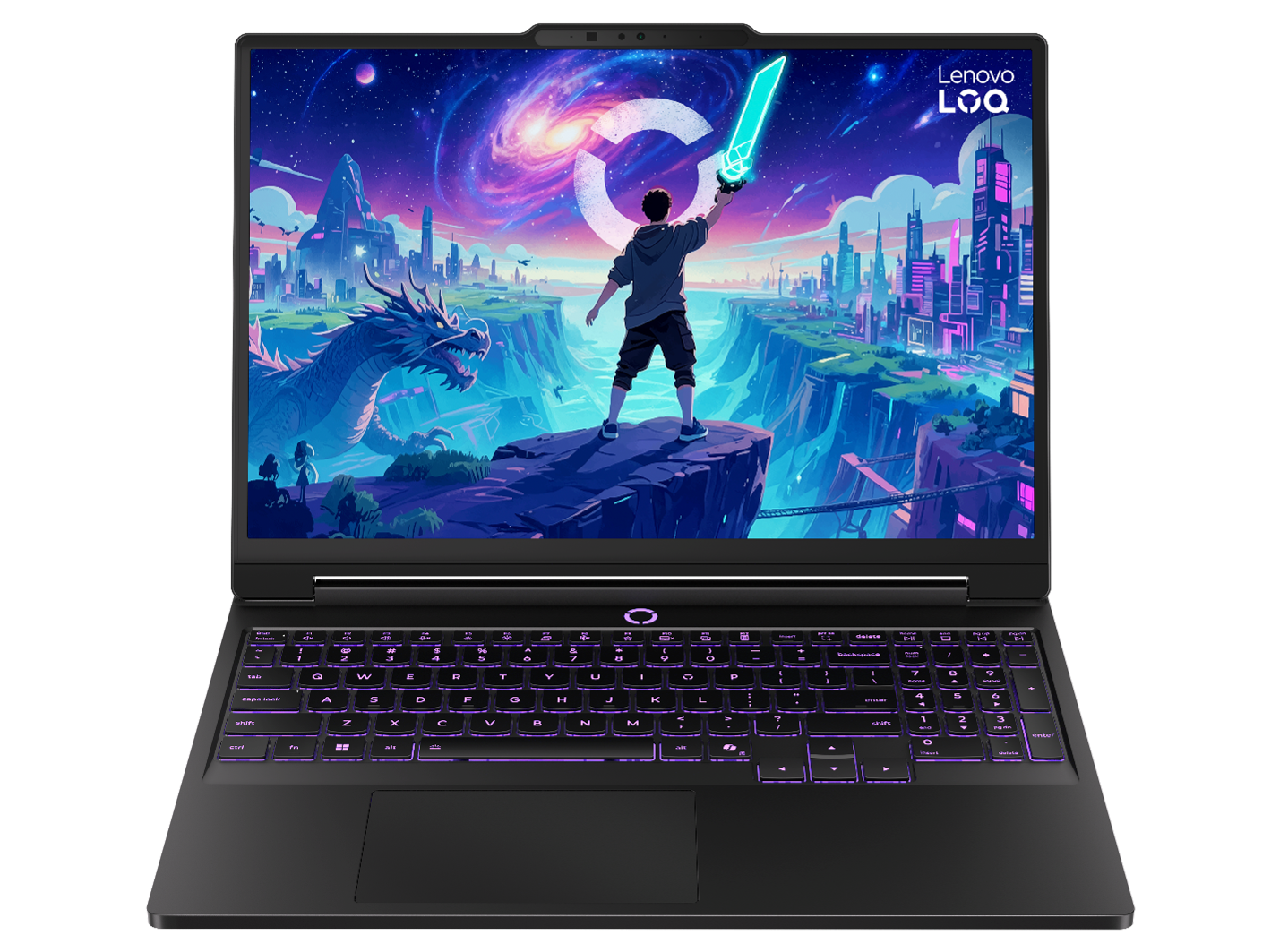
Lenovo just widened the bottom of its gaming laptop lineup, and the split says a lot about how the company sees first-time PC gamers in 2026. The new LOQ Essential 15IPH11 and 15IRH11 laptops, the LOQ Tower 17IRH11 desktop, and two Legion gaming monitors round out a portfolio Lenovo is pitching squarely at students and newcomers, not enthusiasts.
The two LOQ Essential laptops share a 15.3-inch, 16:10 display with up to a 165Hz refresh rate and 100% sRGB coverage, and both are 10% lighter and slimmer than the models they replace. Where they split is graphics, and it is a telling split.
One Chip Skips a GPU Entirely. The Other Keeps a 2022 Card
The 15IPH11 runs an Intel Core Ultra Series 3 chip (Core Ultra X7 358H) with no discrete graphics card at all. Instead it leans on a unified memory architecture that lets the CPU and integrated Intel Arc B390 graphics share one pool of system memory, dynamically shifting capacity toward whatever the game or app needs. Lenovo says that setup also buys up to 21 hours of battery life, since there is no separate GPU pulling power.
The 15IRH11, meanwhile, pairs an Intel Core 200 series chip with an NVIDIA GeForce RTX 3050 Laptop GPU, a card that first shipped back in 2022. It is a strange thing to still be selling as new in a 2026 lineup, but it is also the more familiar, more conventional path into dedicated-graphics gaming, and Lenovo prices it $420 lower than the Arc-based model: $979.99 against $1,399 for the 15IPH11, both expected in October.
Read together, the two laptops are less "which is better" and more "which failure mode you would rather have." Buy the 3050 model and you get an older but known GPU. Buy the Arc model and you are trusting a newer integrated-graphics approach that has never had to prove itself against three-year-old discrete silicon at this price.
A Tower and Two Monitors, on a Slower Timeline
The LOQ Tower 17IRH11 aims higher, with up to an NVIDIA GeForce RTX 5060 Ti, up to 32GB of 5600MT/s DDR5, tool-less access for swapping parts later, and Wi-Fi 7. Lenovo did not attach a global price, saying availability and cost will vary by region.
The Legion 27Q-20 and 27U-20 monitors round out the announcement. The 27Q-20 is a straightforward 27-inch QHD panel at 320Hz for players who want speed above all. The 27U-20 is the more interesting of the two: a Dual Mode display that runs at 4K/180Hz for immersive single-player work, then switches to 1080p/360Hz when a competitive shooter calls for it. Both hit 99% sRGB and 95% DCI-P3 coverage with factory Delta E under 2, and both carry VESA DisplayHDR 400 certification.
The monitors do not land until January 2027, three months after the laptops, at $299.99 for the 27Q-20 and $499.99 for the 27U-20.
Lenovo frames all of it under one banner. "Lenovo's broad gaming portfolio is designed to support every player, regardless of where they are in their gaming journey," said Jun Ouyang, senior vice president and general manager of the Consumer Segment at Lenovo's Intelligent Devices Group. The company continues to lean on its Founding Partner status with the Esports World Cup to keep Legion visible at the high end while LOQ Essential handles the entry point.
None of these products has confirmed Philippine pricing or availability yet. Given the October and January international timelines, local retail listings are worth watching over the next few months rather than expecting day-one availability here.