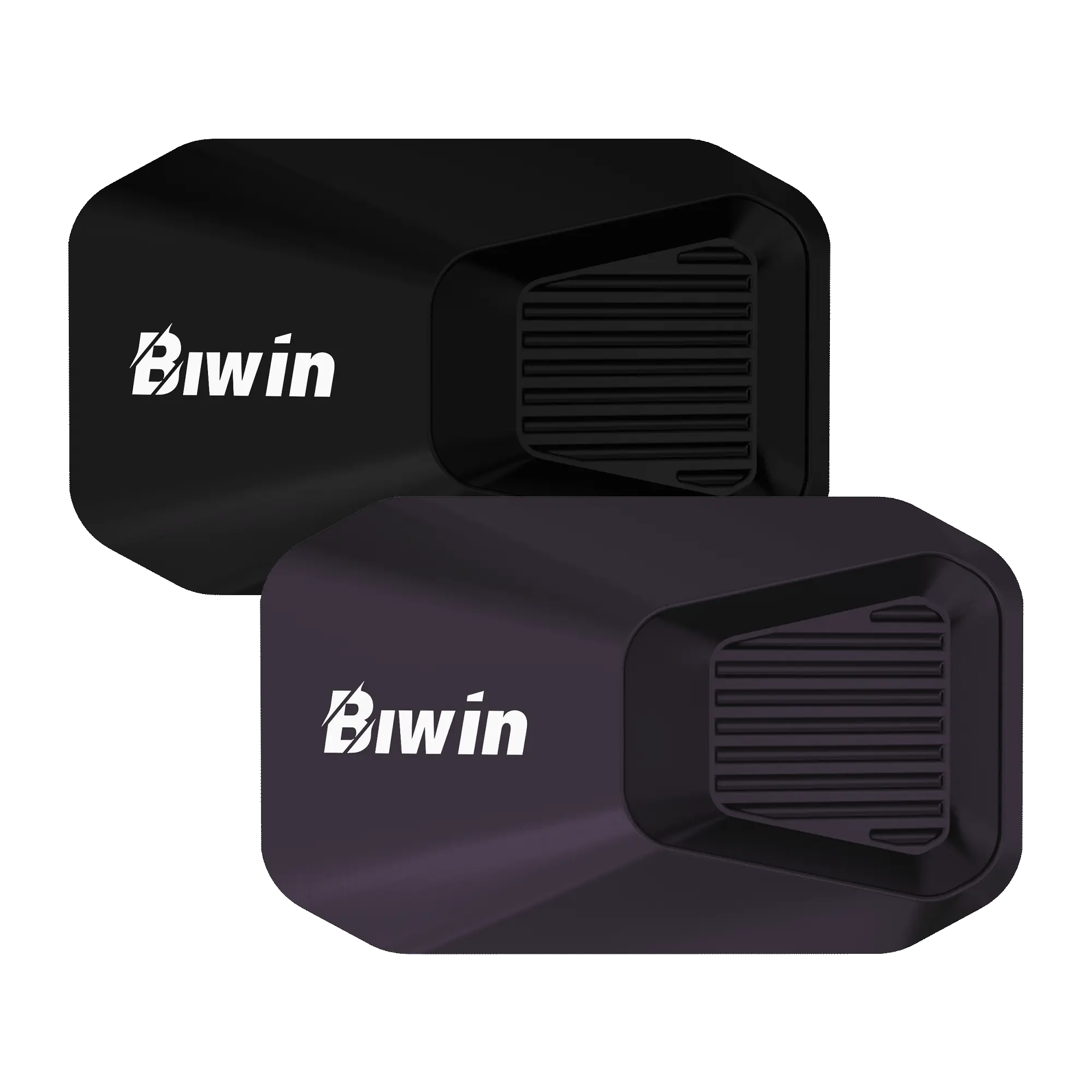
Most USB drives are built for burst transfers: copy a folder, unplug, move on. Biwin's new Amber UV200 is built for the opposite use case, a drive that never really stops writing, because that's what a dashcam actually asks of its storage.
The spec that matters isn't the top speed
Biwin lists the UV200 at up to 200 MB/s read and 80 MB/s write over USB 3.2 Gen1, numbers that look modest next to a flagship SSD. The number that actually predicts real-world behavior is the sustained write rate under Biwin's H2 full-capacity benchmark: at least 60 MB/s, maintained continuously rather than in a burst. Multi-channel dashcam recording and Sentry Mode parking surveillance generate a constant stream of data with no gaps to recover in, and a drive that only performs well for the first few seconds of a write will choke exactly when it's needed most.
Built to disappear into the car, not sit on a desk
The UV200 uses an integrated MUDP structure to keep its footprint ultra-compact, low-profile enough to stay plugged into a dash unit without blocking nearby ports or catching on anything in the cabin. That's a deliberate trade-off against the kind of drive meant to be pulled out and carried around; this one is meant to be forgotten about, plugged in and left there for the life of the car.
Automotive interiors are rougher on electronics than most storage is designed for
Biwin rates the UV200 for operation between -25°C and 75°C, with storage tolerance extending to -40°C and 85°C, plus 1-meter drop protection. Those numbers exist because a car parked under direct sun or left overnight in cold weather puts real thermal stress on flash memory that a desk-bound drive never sees. The high-endurance 3D TLC NAND inside is specifically chosen for repetitive overwrite cycles, the kind loop recording produces by design as old footage gets replaced with new.
Capacity, price positioning, and what it's not for
The UV200 ships in 128GB and 256GB capacities, backed by a three-year limited warranty, and doubles as everyday storage for FLAC and WAV playback through compatible in-car systems. It's not positioned as a general-purpose flash drive competing on raw speed, and buyers looking for the fastest possible file transfer drive should look elsewhere. For anyone running continuous dashcam or Sentry Mode recording, though, the design priorities here track with what actually breaks cheaper drives under that workload.