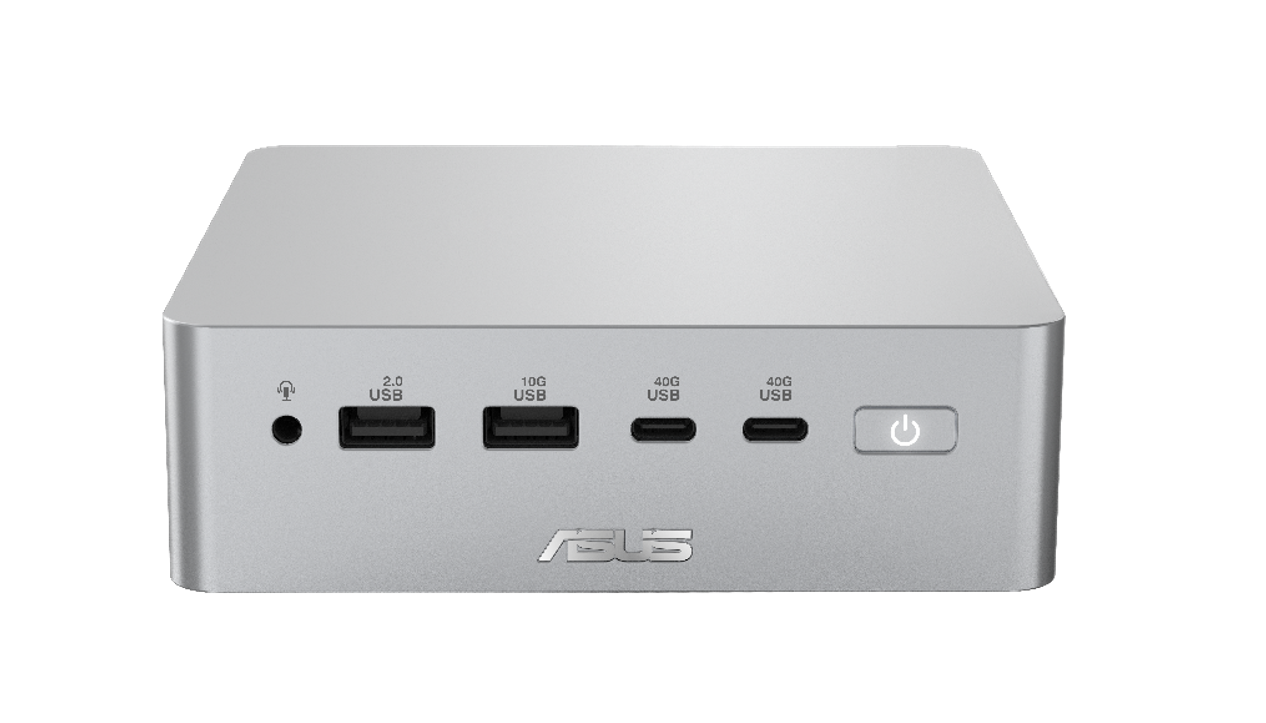
ASUS says the new Ascent QN10 is the world's first AI mini PC built around an 80 TOPS NPU, but the more interesting detail is further down the press release. This isn't an Intel or AMD machine. The QN10 runs on Qualcomm's Snapdragon X2 Elite platform, an 18-core Arm chip, packed into a chassis under 0.7 liters, about 86% smaller than a typical 5-liter mini PC.
That NPU number matters because it clears Microsoft's Copilot+ PC requirement with room to spare, and ASUS is leaning into that headroom rather than treating it as a checkbox. The pitch here isn't "a small desktop that happens to run AI features." It's a device meant to run AI agents locally, hand tasks off to the cloud when it makes sense, and otherwise stay out of the way.
An AI Agent Box, Not a Desktop Replacement
The clearest sign of that shift is in how ASUS describes actually using the thing. The Ascent QN10 supports what ASUS calls "hybrid Agentic AI workflows" through frameworks like OpenClaw and Hermes Agent, and the company specifically highlights letting users interact with AI agents through WhatsApp and LINE. That's not language you'd find in a mini PC pitch even a year ago. Traditional mini PCs sell themselves as compact desktops, HTPCs, or office boxes. The QN10's marketing barely mentions general desktop use at all. It reads closer to a dedicated appliance you plug in, hand a task to through a messaging app, and let work in the background.
The rest of the spec sheet backs that framing. The integrated Hexagon NPU handles up to 80 TOPS for on-device inference, and the examples ASUS lists are real-time translation, video enhancement, content generation, and workflow automation, not gaming or general productivity. Graphics come from an integrated Qualcomm Adreno GPU that ASUS says is 2.3 times faster than the previous generation, but there's no claim about gaming performance anywhere in the release, which tells you where ASUS doesn't expect this thing to spend its time.
The Question ASUS Doesn't Answer
What the release never brings up is the one issue that follows every Arm-based Windows machine: native x86 software compatibility. Windows on Arm has closed a lot of that gap since the first Snapdragon X Elite laptops launched, and Microsoft's Prism emulation keeps improving, but it's still not nothing, especially for a device ASUS is marketing partly at developers and enterprises who may need specific x86-only tools. Security gets more airtime instead. ASUS lists fTPM 2.0, a Microsoft Pluton security processor, and what it calls a "chip-to-cloud" architecture protecting the device, data, and AI workflows across hardware, firmware, OS, and cloud layers.
Connectivity is current-generation, with WiFi 7 and Bluetooth 6.0, plus access to Qualcomm's AI Hub for developers who want to pull from more than 175 pre-optimized models or bring their own. ASUS hasn't published pricing, availability windows, or specific memory and storage configurations for the Ascent QN10, which makes it hard to say yet who's actually going to buy one. The positioning is clear enough on its own, though. ASUS is treating "AI PC" as a category distinct from "PC," built around a chip architecture that, a few years ago, nobody would have picked for a device this deliberately general-purpose.