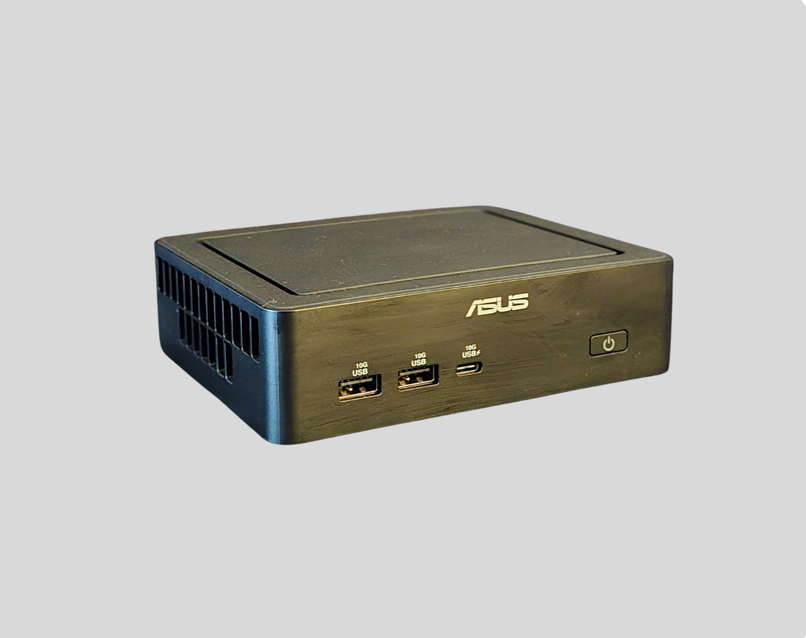
ASUS is exploring cooling with no moving parts. At Computex 2026, solid-state cooling company Ventiva announced a partnership with ASUS to test its ionic cooling technology in future NUC and Mini-PC designs, and it showed a working ASUS NUC demo platform on the show floor.
The idea is genuinely different from the fans every PC has used for decades. Ventiva's technology uses electrohydrodynamic flow to move ionized air molecules through an electric field, pushing air with a tiny plasma field instead of a spinning blade. The result is airflow with no fan, no vibration and, by Ventiva's anechoic-chamber testing, less than 15 dBA of noise. That is effectively silent.
Why this matters for small PCs
The problem Ventiva is chasing is real. AI workloads pack more processing into smaller boxes, and traditional fans eat board space, dictate where components can sit and add vibration that gets harder to hide as devices shrink. Think of a fan as a roommate who needs their own room and plays music at all hours. Ventiva's module is more like a quiet tenant who fits in a closet.
Each module combines a self-contained air blower, a fin stack and a vapor chamber or heat pipe, delivering up to 1.1 CFM per device. Because it draws air side-in and side-out rather than top-in and side-out, it can sit as low as 5mm tall and be placed right next to hot spots like the SoC, memory or power delivery. That frees up layout room a conventional fan never could.
An exploration, not a product yet
It is worth being clear about what this is. Both companies framed it as an early phase focused on prototype development and technical evaluation, not a shipping product. As ASUS engineer Alex Gilpin put it, both teams are still assessing what is possible. Ventiva's Christian Schlachte made the broader case that cooling is shifting from a component-level afterthought to a platform architecture decision, since how you cool a system shapes what you can build.
For now, no NUC ships with this. But fan-free, silent cooling in a mainstream Mini-PC would be a real change, and seeing ASUS put a demo unit on the Computex floor suggests the interest is more than theoretical. One to watch.