

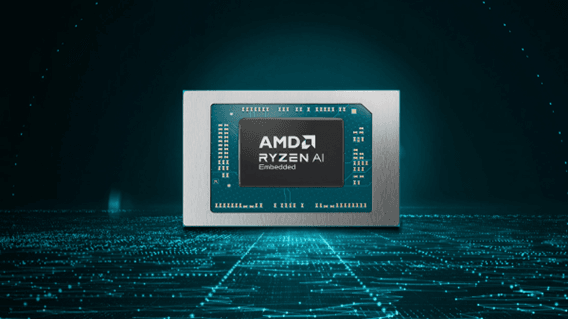
AMD is expanding its embedded processor portfolio with new Ryzen AI Embedded P100 Series chips, targeting industrial automation, robotics, and edge AI deployments that require real-time processing and long-term reliability.
The new processors are designed for always-on environments such as factory systems, autonomous machines, and medical devices, where consistent performance and predictable latency are critical.
Higher Compute Density in the Same Footprint
The updated P100 Series focuses on scaling performance without increasing system size. AMD claims the new chips deliver up to twice the CPU core count, up to eight times GPU compute performance, and around 36 percent higher system AI throughput measured in tera operations per second compared to earlier P100 variants.
These gains come within the same compact BGA package, which is a key requirement for embedded deployments where space and thermal limits are tightly constrained.
At a hardware level, the processors integrate:
- 8 to 12 “Zen 5” CPU cores
- AMD RDNA 3.5 graphics
- An XDNA 2-based neural processing unit for low-power AI inference
Combined, the platform can deliver up to 80 TOPS of AI performance on a single chip, enabling more complex edge workloads without relying on external accelerators.
Built for Real-Time Edge AI Workloads
AMD is positioning the P100 Series for a range of edge use cases that increasingly blend compute, AI, and visualization into a single system.
In industrial environments, the processors can consolidate programmable logic controllers, machine vision systems, and human-machine interfaces into a single industrial PC. This reduces system complexity while maintaining the compute headroom needed for real-time inspection and automation.
For robotics, CPUs handle navigation, planning, and control logic, while GPUs process multi-camera inputs for spatial awareness. The integrated NPU supports always-on inference for object detection and scene understanding, enabling more responsive autonomous systems.
Healthcare is another target segment. AMD highlights support for 3D imaging workloads such as ultrasound and endoscopy, alongside AI-assisted diagnostics and reporting pipelines running directly at the edge.
Performance Gains Over Previous Generations
Compared to the Ryzen Embedded 8000 Series, AMD estimates up to 39 percent higher multithreaded CPU performance and up to 2.1 times higher total system AI throughput.
The platform is also designed to support larger AI models and increased virtualization density, allowing more workloads to run concurrently on a single system.
This reflects a broader shift in edge computing, where systems are expected to handle mixed workloads that combine AI inference, traditional applications, and real-time control systems.
ROCm Brings Open AI Software to the Edge
A key part of the platform is support for AMD’s ROCm software stack, which brings an open-source AI ecosystem to embedded deployments.
ROCm enables developers to run standard AI frameworks without needing to rewrite code for different hardware targets. It uses the HIP programming model to abstract GPU programming, helping reduce vendor lock-in and simplifying cross-platform development.
AMD is also offering a virtualized reference stack built on the Xen hypervisor. This allows multiple operating systems, including Linux, Windows, Ubuntu, and real-time operating systems, to run in isolated environments on the same hardware.
Designed for Long Lifecycle Deployments
Unlike consumer processors, embedded platforms prioritize longevity and stability. The P100 Series supports industrial temperature ranges from negative 40 to 105 degrees Celsius, 24/7 operation, and up to a 10-year lifecycle.
This makes the platform suitable for deployments where hardware replacement cycles are measured in years rather than months.
Availability and Industry Adoption
AMD says eight- to 12-core P100 Series processors are currently sampling, with production shipments expected to begin in July 2026. Lower core-count variants are expected to enter production earlier in the second quarter of 2026.
Early ecosystem support includes partners such as Advantech, congatec, and Kontron, which are already developing modules and systems based on the new processors.
Market Context
The launch reflects increasing demand for edge AI systems that can operate independently of cloud infrastructure while still handling complex workloads.
By integrating CPU, GPU, and NPU resources into a single chip and pairing it with an open software stack, AMD is positioning the Ryzen AI Embedded P100 Series as a flexible platform for next-generation industrial and AI-driven edge deployments.
In practical terms, this is less about raw peak performance and more about consolidation. The ability to run multiple workloads on a single, power-efficient system is becoming the defining requirement for edge computing.